
"Annual production"
8000 article(s) found

Distribution of Ethiopian Coffee production how to make good Coffee in Ethiopia
Professional coffee knowledge exchange more information on coffee beans Please follow the coffee workshop (Wechat official account cafe_style) Coffee first discovered that the Kafa continent in southern Ethiopia was located in the place name Kaffa, and it was not officially named after Coffee until the 18th century. The geographical environment of Ethiopia is very suitable for coffee growth. nowadays, coffee is mainly grown between 1100 meters and 2000 meters above sea level. Now

An introduction to the Cooperative of the Annual output of Coffee beans in the Jade Manor of Panama
The annual output processing plant of coffee beans in the Emerald Manor of Panama the cooperative said that in 1996, Brais and Rachel visited a farm that was on sale in the Haramijun area of the Bocketi Valley, and was attracted by this beautiful farm and immediately bought it. This is Esmeralda. Daniel Lou, the third son of Haramiqiong Farm. Mr. Bidasson planted the coffee world in this farm.

Ethiopian Coffee Boutique Flavor Manor Producing Area Taste Introduction Ethiopian Coffee Brand
1. Limu coffee grows between 1400 meters and 2000 meters above sea level. washed coffee. Excellent quality, with intense nutty aromas, moderate acidity and wine intensity. Annual production of 29,000 tons. Gima coffee grows between 1400 and 1800 meters above sea level. Sunburn coffee. Slightly sour, nutty and long finish. Annual production of 70,000 tons. 3. Gambi Coffee
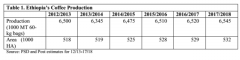
Annual report on Ethiopian Coffee 2017
Ethiopia's coffee production is expected to remain at 6.545 million bags in 2017 / 18. The export is expected to be 3.31 million bags. In June this year, in order to stimulate exports, the government plans to reform the coffee marketing and trading system, one of the most anticipated is that coffee will no longer have to go through the Ethiopian Commodity Exchange (ECX) (ECX trading process and system principles are described in the next article.

A brief introduction to the Annual output of Coffee beans in Kahayang Ganzhuang, Indonesia
The fact that national coffee exports are used as capital at the world-class level makes Indonesians more interested in entering the coffee industry, whether it is roasting coffee, opening coffee shops, or opening shop consultations. as a result, the growth of domestic coffee consumption is not just in terms of the number of products. In order to encourage the better development of quality coffee, the coffee business still needs consumers to understand and accept more when Indonesia

The gold standard of Rosa Village in Ethiopia accounts for only 3.7% of the annual output.
Professional coffee knowledge exchange more coffee bean information please pay attention to the coffee workshop (Wechat official account cafe_style) rose summer village Gesha Village internal classification is also divided into competitive bidding, gold bid, red mark, green mark, Chaka batch, rose summer village includes three varieties, namely, Gori rose summer (Gori Gesha), rose summer 1931 (Gesha 1931), Illubabor (E)

Introduction to the flavor and taste of Dominican boutique coffee beans and the characteristics of the manor producing area
The earliest coffee in Dominica was introduced from Martinique (the overseas province of France), dating back to the early 18th century. Dominica is an island country with a tropical climate. The temperature changes little throughout the year. Except for the lower temperature in the Central Cordillera Mountains, which can reach less than 0 ℃ in winter, the annual average temperature in other areas is between 25 and 30 ℃, which is affected by the mountain topography.

Costa Rican Coffee processing Plant Costa Rican Coffee from Tarazu Coffee production area
Costa Rican coffee cultivation was introduced by Cuba in 1779 and exported for the first time in 1820. There are about 32000 coffee farmers, with an average planting area of less than one hectare (10000 hectares) per farmer. Costa Rica has a population of 41 billion (2006), with a coffee planting area of 82500 hectares and an annual production of 1.7 million bags (60kgs per bag). The annual domestic consumption is 380000 bags.
Annual output of Kenyan coffee the Kenyan coffee industry is showing signs of continuous decline
Professional coffee knowledge exchange more coffee bean information Please pay attention to the coffee workshop (Wechat official account cafe_style) in recent years, due to low rate of return and poor management, coffee production in Kenya has been declining year by year, the coffee industry is showing a declining trend. According to the latest data from Kenya's National Bureau of Statistics, Kenya's coffee exports fell to 2021 from 2639 metric tons in January 2020.

Colombian Ramon Coffee Bean Flavor description, taste characteristics, grinding scale variety manor
Colombian Ramon coffee bean flavor description grinding scale variety manor introduces that in many parts of Colombia, the elevation is between 1200 meters and 1800 meters, and the annual rainfall is about 2000 millimeters. Sufficient sunshine and rainfall are very suitable for coffee growth. In recent years, however, Jos é Ramon Corazos, who lives in the southern province of Uila, has gradually found that there is less and less coffee on his plantation.
Ethiopia coffee production area profile Ethiopia West Dharma
Harar/Sundried/Dry-Processed Harar is located in the Eastern Highlands of Ethiopia (Haredge Province) and grows at an altitude of 5,000 - 7,000 feet. It was still wild on hillsides a century ago. Most raw beans are medium in size and pointed at both ends. The color is green with yellow or gold. When baked, it has a strong chocolate smell.

Current situation of coffee sales in Tanzania | African coffee bean market | Coffee origin information
Professional coffee knowledge exchange more coffee bean information Please follow Coffee Workshop (Wechat official account cafe_style) recently, Tanzanian Minister of Agriculture Charles Stizeba said that coffee growers and coffee supply and marketing cooperatives in Tanzania will start in July and can only sell coffee through annual coffee auctions under the supervision of the Tanzanian Coffee Council. Tizeba explained, Tong

Introduction to the producing area of grinding scale varieties by the method of describing the flavor of Ethiopian Sidamoguji coffee beans
Ethiopian Sidamoguji Coffee Bean Flavor description processing method Grinding Calibration Variety production areas introduce the natural characteristics of coffee beans including large

Introduction to Coffee Climatic cultivation in Ethiopia
Following Kaiping (official Wechat account vdailycom) has found that climate change may cause about half of Ethiopia's coffee-growing areas to become unsuitable for coffee cultivation by the end of the century. However, the study report is not all bad news, the researchers also proposed that through the transfer of coffee producing areas, afforestation and forest protection, the total area of coffee cultivation is expected to expand
World-famous Ethiopian coffee bean variety Kenyan flavor Sidamo flavor
The world-famous Ethiopian coffee mainly includes: 1. Limu coffee grows between 1400 meters and 2000 meters above sea level. washed coffee. Excellent quality, with intense nutty aromas, moderate acidity and wine intensity. Annual production of 29,000 tons. Gima coffee grows between 1400 and 1800 meters above sea level. Sunburn coffee. Slightly sour, nutty and long finish. annual output of

Long aftertaste Colombia Na Linglong fine coffee bean varieties planting market price profile
Colombia's favourable climate provides a truly natural pasture for coffee. Coffee trees in Colombia are mainly cultivated in the Andes mountains, on steep slopes up to 1,300 meters above sea level, where the annual temperature is about 18 degrees Celsius, the annual rainfall is 2000 to 3000 mm, the latitude is 1 - 11 15, the longitude is 72 - 78, and the specific altitude range can exceed 2.000 meters. by

The annual output of coffee in Indonesia introduces the planting environment of coffee beans and the introduction of Kahayang Ganzhuang.
When Indonesian consumers know more about quality coffee, there is an increase in the number of special coffee shops, according to coffee owners: in big cities like Jakarta, Surabaya, Bandung and Bali, special coffee shops are growing rapidly, which also shows that consumers know more about coffee, and coffee shopkeepers must choose high-quality coffee ingredients.

Unique aromatic Ethiopian Coffee Flavor Taste introduction to Fine Coffee in Manor production area
Coffee is Ethiopia's most important export cash crop and the main source of Ethiopia's foreign exchange earnings. Ethiopia's coffee exports account for about 3% of the world market, making it the eighth largest coffee exporter in the world. Coffee exports increased steadily from 58000 tons in 1990 to 110000 tons in 1995-1996 and remained at this level in the following years. 2001-2002

A brief introduction to the market price of Columbia's exquisite boutique coffee beans
The annual temperature there is about 18 degrees Celsius, the annual rainfall is 2000 to 3000 mm, latitude 1-11 15 north, longitude 72-78 west, the specific range can exceed 2.000 meters above sea level. By a special combination of factors, the latitude, altitude, soil, plant origin of species and varieties of coffee in the coffee growing areas of Colombia, the climate and tropics of the coffee growing areas

High-balanced Columbia exquisite boutique coffee bean cultivation geographical location, climate, altitude is simple.
The annual temperature there is about 18 degrees Celsius, the annual rainfall is 2000 to 3000 mm, latitude 1-11 15 north, longitude 72-78 west, the specific range can exceed 2.000 meters above sea level. By a special combination of factors, the latitude, altitude, soil, plant origin of species and varieties of coffee in the coffee growing areas of Colombia, the climate and tropics of the coffee growing areas